


| Mould Treatment
Mould isn’t just unsightly, it’s a serious health hazard. Exposure can cause respiratory problems, allergies, and long-term health issues, especially for children and vulnerable tenants. For landlords, ignoring mould is not just a risk to tenant health, it’s now a legal liability.
With Awaab’s Law already enforcing strict timeframes for social housing and soon extending to private rentals, acting quickly is critical. Professional mould treatment ensures your properties are safe, compliant, and protected from future damage.
Why Private Landlords Should Act Now
● Health First: Protect your tenants from dangerous mould exposure.
● Legal Compliance: The law will soon require private landlords to investigate mould within 10 working days and make properties safe within 5. Emergency hazards must be resolved within 24 hours.
● Prevent Costly Damage: Early action avoids structural damage, repeated repairs, and potential liability claims.
● Getting ahead of mould issues now means your properties are safe, healthy, and fully prepared for the upcoming legal requirements.
What is Awaab's Law?

Awaab’s Law is UK legislation introduced after the tragic death of Awaab Ishak, a 2-year-old who died from prolonged exposure to mould in his social housing home. The law sets legally binding timeframes for landlords to investigate and resolve damp and mould hazards in rental properties, making the safety and health of tenants a legal priority.

Awaab’s Law – What Private Landlords Need to Know
● Investigation: Reported mould must be assessed within 10 working days.
● Repair: Properties must be made safe within 5 working days (24 hours for emergencies).
● Written Summary: Tenants must receive a summary of the investigation within 3 working days.
● Alternative Accommodation: If immediate repairs aren’t possible, landlords must provide temporary accommodation.
● The message is clear: landlords who delay mould treatment risk legal action, tenant complaints, and financial penalties. Acting now safeguards both tenants and your investment.
Our 4‑Step Mould Treatment Process
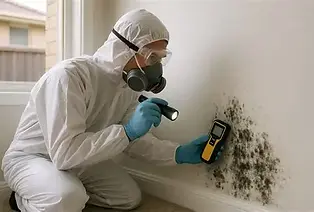
Our four-step mould treatment process is highly effective because it targets mould at the source. We use biocidal products, which are specially formulated to kill mould spores completely and prevent regrowth, far more effective than home remedies like apple cider vinegar or shop bought products containing bleach, which may clean the surface but cannot penetrate deeply or stop mould from returning.
1. Identify
We begin with a comprehensive inspection of the affected area identifying not just the visible mould, but also its underlying causes, such as damp, condensation, or leaks.
2. Bacdet
Bactdet is a fungicidal wash and sterilising solution used to kill existing mould, neutralise spores, and clean any contaminated surfaces before further treatment.
3. Halophen
Halophen is a fungicidal barrier solution designed to penetrate into porous building materials to kill
mould roots and prevent future regrowth.

4. Bio-Check Paint
Finally, we coat the treated area with a specialised fungicidal and anti-condensation, Bio-check
emulsion, that prevents mould from growing and to create a long-lasting, mould-resistant barrier.
.webp)
"We only use MGC primary fungicidal treatments to treat mould as these are officially approved by Health and Safety Executive (HSE) and we know they work"
Our Approach to Mould Treatment
We do more than treat visible mould. Our team is trained to identify and address the underlying cause, helping to prevent the issue from returning.
As part of this process, we assess the property both internally and externally to determine whether remedial work is required. This may include:
Improving ventilation systems
●
Addressing penetrating damp
●
Resolving DPC issues
●
Mould Treatment FAQs
Q: How quickly can mould be treated?
These products are safe to use in homes with children and pets, but only after the treated surfaces have completely dried.
Children and pets should be kept away during the treatment process.
Q: Is the treatment safe for children and pets?
Yes. The products we use are biocidal, so children and pets should be kept out during treatment. Once fully dry, the area is completely safe.
Q: How long does it take to dry?
Cleaners and Fungicidal Washes (Bactdet) are Touch dry within 30 minutes to 2 hours.
Paints and Coatings (Biocheck) is Touch dry in 2–4 hours; if applying a second coat, wait at least 2–4 hours for proper depth and adhesion.
Q: Can mould return after treatment?
Mould may return if the underlying moisture problem isn’t fixed. Our process addresses both the mould and its source, giving a long-lasting solution.
Q: How is this different from home remedies like vinegar?
Home remedies may clean the surface but cannot kill spores deep in the material or prevent regrowth. Our professional biocidal treatments remove and kill the mould spores providing long lasting protection from mould.
Q: How does this relate to Awaab’s Law?
Social housing landlords must address all emergency hazards within 24 hours, and investigate significant damp and mould hazards within fixed timescales, reporting findings back to the tenant. The law will soon extend to private landlords, making timely treatment essential for legal compliance and tenant safety.
Q: Do I need to ventilate the room?
Yes. Good ventilation during and after treatment helps the products work effectively and ensures the area dries safely.